Like a scientist:
Why an explicit focus on science skills is crucial for students’ science success
Science skills have a stronger emphasis in the Victorian Curriculum F–10 Version 2.0 because scientific literacy is defined not only by knowledge of scientific concepts, but also by the ability to investigate, analyse evidence, and apply science in real-world situations.
In a world where information is abundant, contested and uneven in quality, students can access facts instantly. That makes skills such as analysing data, evaluating evidence, and distinguishing credible claims from misinformation far more important than memorising content.
VCAA study designs and assessment advice emphasise that students must demonstrate key science skills, such as analysing data and communicating scientific explanations, as part of their performance in VCE science subjects, reflecting the emphasis on scientific practices in the curriculum. This shift is also reflected in VCE examinations, where students are increasingly required to analyse data, interpret models and justify conclusions using unfamiliar contexts.
Science skills stronger than ever in the new curriculum
While the five Science Inquiry Skills were present in the previous Victorian Curriculum Version 2.0 makes their role more explicit and positions them more centrally within learning and assessment.
The Science Inquiry Skills in the Victorian Curriculum 2.0
- Questioning and predicting
- Planning and conducting
- Processing, modelling and analysing
- Evaluating
- Communicating
In the earlier curriculum, inquiry skills were structured as a parallel strand to content and were often interpreted as a context for learning rather than the primary means through which understanding was demonstrated.
By contrast, Version 2.0 integrates inquiry more closely with content and foregrounds how students use evidence, data and models to construct and justify scientific explanations. This is evident in the achievement standards, which increasingly require students to analyse, evaluate and justify claims using multiple sources of evidence, particularly in Years 9 and 10.
Laying skills foundations from Years 7-10
While the five Science Inquiry Skills were present in the previous Victorian Curriculum Version 2.0 makes their role more explicit and positions them more centrally within learning and assessment.
The increased emphasis on science skills in the new Victorian Curriculum supports stronger foundations for academic success in senior science, including Year 12 examinations.
When skills such as analysing data, evaluating evidence and communicating scientifically are developed deliberately across Years 7–10, students enter VCE better prepared for the kinds of questions that reward application, reasoning and justification, not just recall.
Embedding these skills early means students build confidence with evidence-based thinking over time, rather than encountering it for the first time in Year 12. This approach aligns teaching and assessment with what VCE science values, without reducing learning to exam preparation.
Just as importantly, working with real-world data, models and contemporary contexts helps students relate science to the information they encounter through media and everyday life. Developing the ability to question and critically evaluate scientific claims supports engagement, scientific literacy and confidence in tackling unfamiliar problems.
The table below compares the Year 7 achievement standards in the Victorian Curriculum Version 1.0 with those in Version 2.0, illustrating a shift from a focus on knowledge acquisition to an emphasis on interpretation, application and the societal impact of scientific knowledge.
While Version 1.0 emphasises understanding and applying scientific concepts, Version 2.0 positions students as critical interpreters of scientific knowledge who evaluate evidence, consider ethical and societal implications, and communicate for impact. This represents a shift in both cognitive demand and the purpose of science education.
Do whales have belly buttons?
By using science skills as the entry point to learning, lessons are designed to increase both engagement and depth of understanding.
Take a familiar Year 7 topic like classification. Rather than beginning with a presentation of animal groups and their defining features, learning can begin with a simple, curiosity-driven question: Do whales have belly buttons? This invites students to question, predict and justify their thinking from the outset.
From there, comparisons unfold naturally - whales and fish, fish and sharks, whales and hippos - with each step requiring students to use evidence, identify patterns and refine classifications.
By leading with curiosity and comparison, reasoning, evidence use and scientific communication become the engine of learning. This gives students a reason to care about the content and supports learning that is more memorable, meaningful and aligned with the skills emphasised in the Victorian Curriculum.
Why science skills are essential for VCE success
Across Biology, Chemistry, Physics and Psychology, recent VCE examinations consistently emphasise students’ ability to use scientific skills rather than rely on content recall alone. High-value questions commonly require students to analyse data, interpret models, justify conclusions and respond to unfamiliar contexts.
While recall remains part of each exam, it plays a limited role in distinguishing student performance. Recent exam papers increasingly present data or stimulus material from the outset, requiring sustained analysis and reasoning throughout questions.
As a result, VCE science exams reinforce the same core skills year after year, making their deliberate development essential rather than optional.
the five Science Inquiry Skills were present in the previous Victorian Curriculum Version 2.0 makes their role more explicit and positions them more centrally within learning and assessment.
The increased emphasis on science skills in the new Victorian Curriculum supports stronger foundations for academic success in senior science, including Year 12 examinations.
When skills such as analysing data, evaluating evidence and communicating scientifically are developed deliberately across Years 7–10, students enter VCE better prepared for the kinds of questions that reward application, reasoning and justification, not just recall.
Embedding these skills early means students build confidence with evidence-based thinking over time, rather than encountering it for the first time in Year 12. This approach aligns teaching and assessment with what VCE science values, without reducing learning to exam preparation.
Just as importantly, working with real-world data, models and contemporary contexts helps students relate science to the information they encounter through media and everyday life. Developing the ability to question and critically evaluate scientific claims supports engagement, scientific literacy and confidence in tackling unfamiliar problems.
The table below compares the Year 7 achievement standards in the Victorian Curriculum Version 1.0 with those in Version 2.0, illustrating a shift from a focus on knowledge acquisition to an emphasis on interpretation, application and the societal impact of scientific knowledge.
Science skills exam question examples
Biology - Evaluating evidence
In Section B, Question 1e of the 2024 VCE Biology examination, student performance dropped sharply when evaluation, rather than explanation, became the focus.
Although most students possessed the necessary knowledge of protein synthesis, the task required them to critically examine the scientific model itself by identifying a limitation and proposing a way it could be addressed.
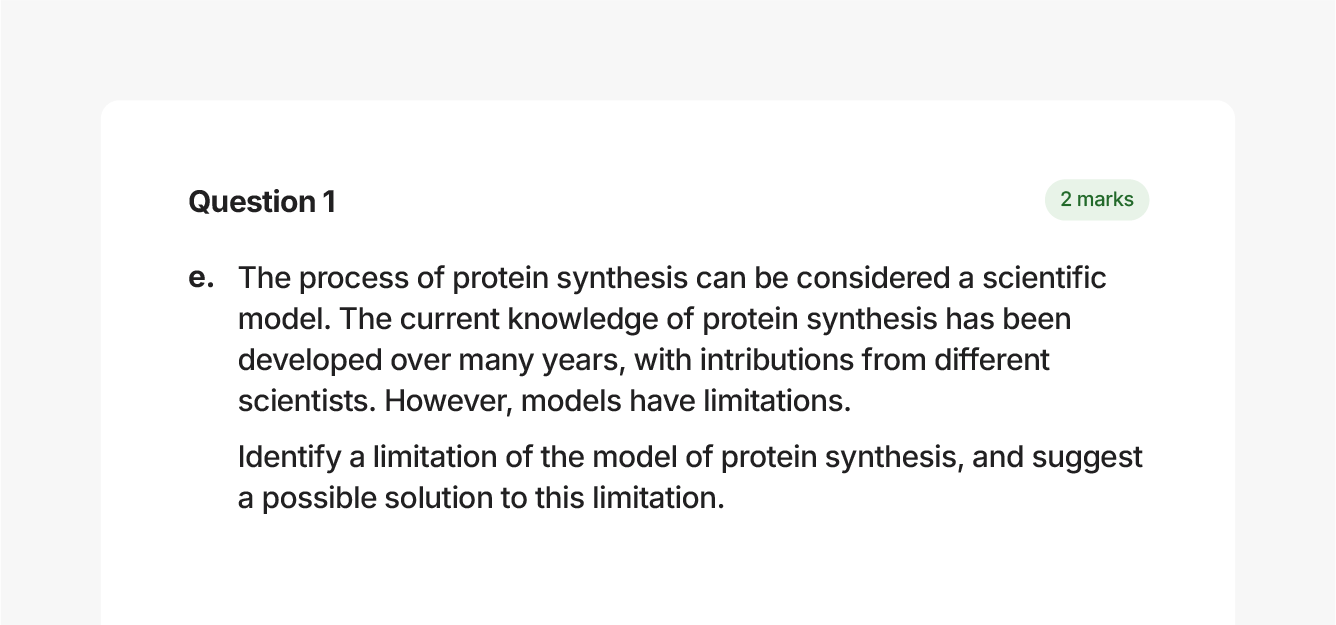
According to the 2024 VCE Biology examination report, this question was answered poorly, with an average score of 0.7 out of 2 and more than 50% of students scoring zero. The report notes that many students focused on weaknesses of the biological process, rather than evaluating the model as a simplified representation used to organise and explain complex phenomena. High-scoring responses demonstrated an ability to judge the model’s explanatory power and constraints.
The challenge here was not content difficulty. It stemmed from the cognitive demand of the task. Students were required to:
- Differentiate between a process and its model
- Critically assess what the model includes and omits
- Explain the significance of those omissions
- Propose a reasoned improvement
The challenge for students was not knowledge, but evaluation as a scientific skill.
Chemistry – Processing, modelling and analysing data
In Section B, Question 8b.iv of the 2024 VCE Chemistry examination, where students were required to demonstrate data processing and interpretation, rather than chemical recall. The question asked students to determine the resolution of laboratory equipment, an electronic balance and a burette, based on how measurements were recorded, requiring them to infer precision from evidence rather than read it directly.
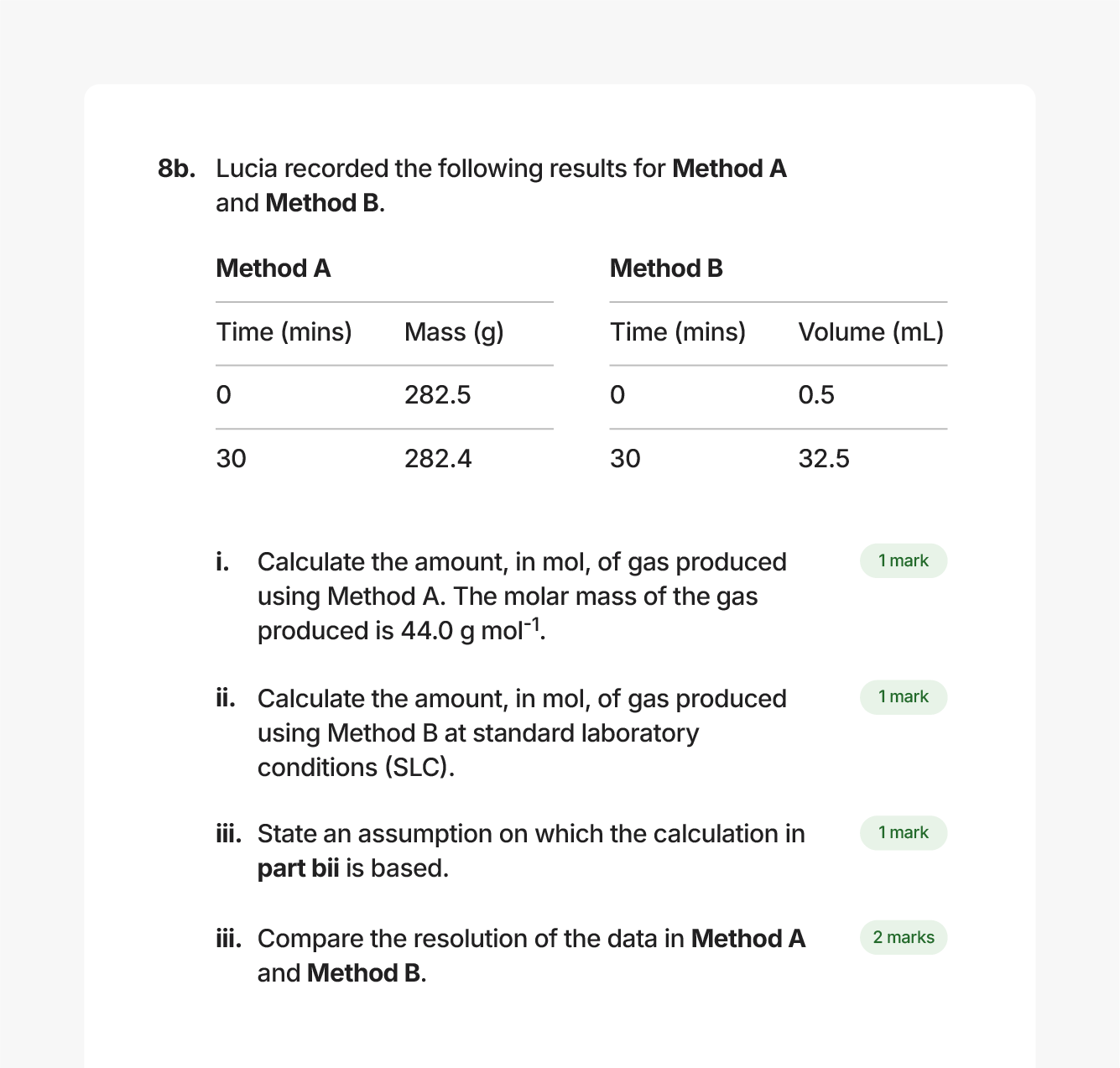
The 2024 Chemistry examination report shows this question was answered extremely poorly, with an average score of 0.2 out of 2 and 86% of students scoring zero. While many students correctly identified the balance resolution, most were unable to determine the burette resolution from its graduation spacing, despite this expectation being clearly outlined in the Study Design. High-scoring responses depended on applying conventions about measurement uncertainty and units, not recalling definitions.
As with Biology (and the other subject examples), the difficulty did not lie in unfamiliar content. Students struggled because they had to interpret data, apply procedural rules, and use evidence to justify an answer, revealing data analysis as another critical science skill that is commonly underdeveloped.
Physics – Processing, modelling and analysing data
In Section B, Question 16b of the 2024 VCE Physics examination, students were asked to construct and interpret a line of best fit from experimental data. Rather than recalling formulas or definitions, students needed to model data appropriately by considering all plotted points and representing the underlying trend accurately.
The 2024 VCE Physics examination report shows this question was answered poorly, with a large proportion (53%) of students losing marks because they ruled their line of best fit through the first and last data points only, ignoring the remaining data. This error is explicitly noted by assessors as persistent and conceptually incorrect, and has appeared repeatedly in previous years.
As with the other subjects, the difficulty was not conceptual Physics content. Students struggled because they were required to:
- Treat data as evidence, not decoration
- Model a relationship, rather than connect two extreme points
- Apply conventions of scientific graphing, including trend representation
- Demonstrate understanding visually, not just numerically
This question highlights data modelling as a distinct science skill: one that is assumed by the curriculum, frequently assessed, but still poorly mastered by many students.
Psychology – Evaluating evidence
Question 9 in Section B of the 2024 VCE Psychology extended-response question illustrates how strongly VCAA assesses evaluation as a science skill, rather than content recall alone. Although most students demonstrated sound knowledge of CBT, synaptic plasticity and amygdala function, only 1% achieved full marks because high-level responses required students to evaluate the model’s applicability.
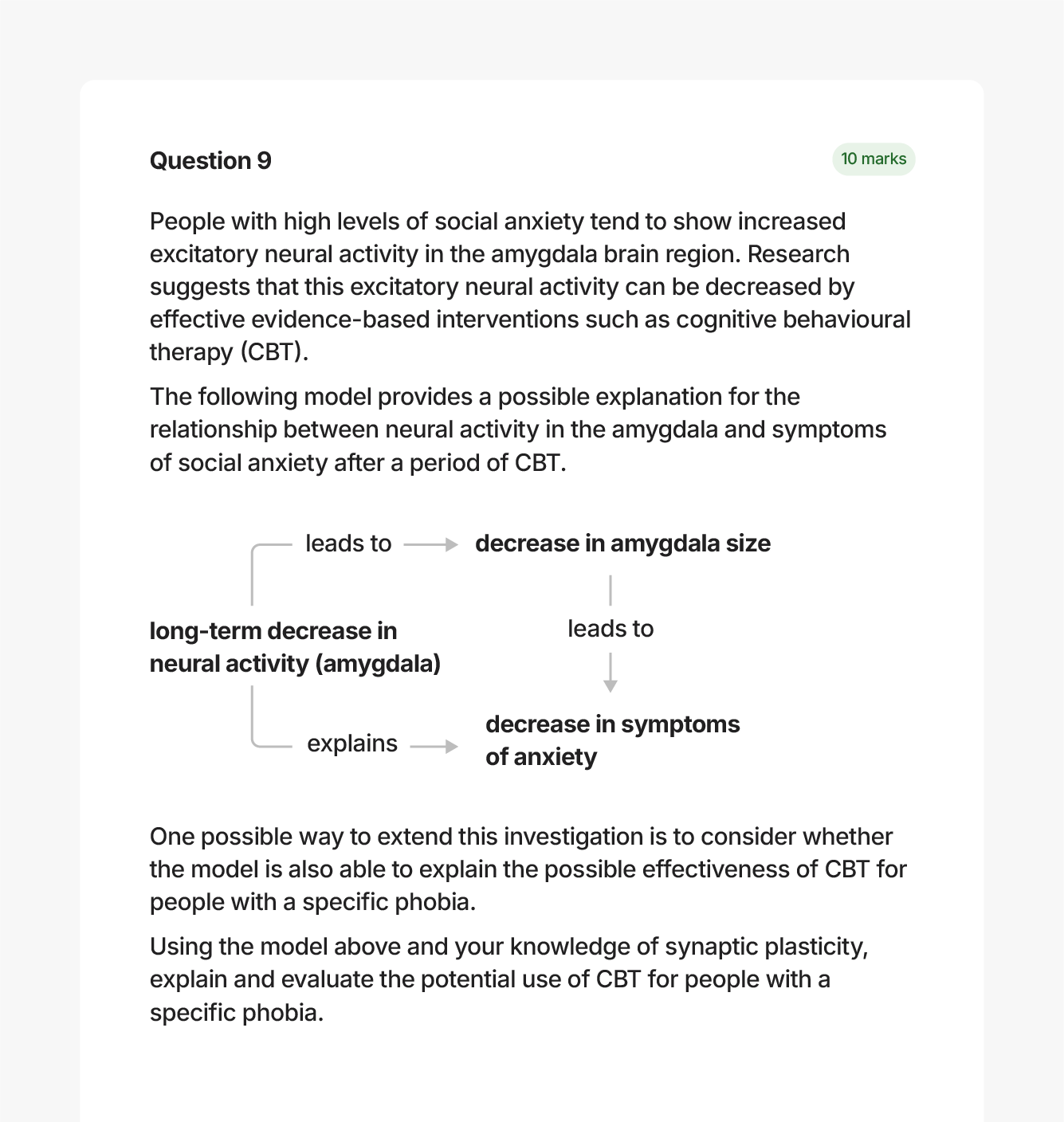
The 2024 VCE Psychology assessment report shows that a tin 1% of the state scored full marks on this question, and the average mark was 4.4. The report makes clear that students who explained mechanisms well but failed to weigh strengths, limitations and implications were capped at mid-range scores. Success depended on constructing an evidence-based judgement, balancing pros and cons and reaching a justified conclusion, highlighting evaluation literacy as a critical, and commonly underdeveloped, scientific skill.
What this reveals is this was not a “hard content” question. It was hard because students had to:
- Transfer a model from social anxiety to specific phobia
- Evaluate applicability, not just describe mechanism
- Balance:
- why CBT could work (amygdala activity, synaptic plasticity, extinction learning)
- why it might not fully explain outcomes (heterogeneity of phobias, other brain regions, behavioural vs neural change)
- Conclude, using evidence, not opinion
Unfortunately most students stopped at Step 2. Evaluation therefore operated as a bottleneck skill: rarely practised, lightly distributed across the exam, but the differentiator for high-level performance.
Common VCE science exam pitfalls
We analysed the 10 most common pitfalls on VCE exams, and how to help students avoid them. Click to read more
How Edrolo gives you a skills-explicit curriculum
VCE sciences
All our VCE science courses for Biology, Chemistry, Physics and Psychology include skills videos that unpack the key science skills, and application of these for in the specific science subject. For Edrolo Daily Practice and Daily Plus subscribers, there’s also additional key science skill questions to accompany these videos that help students put the skills into practice.
The questions in all courses are written by experienced VCE teachers and mapped backwards from exam success. The questions model the specific content and skills that students will need to be able to demonstrate on the exams, well before they tackle the real thing.
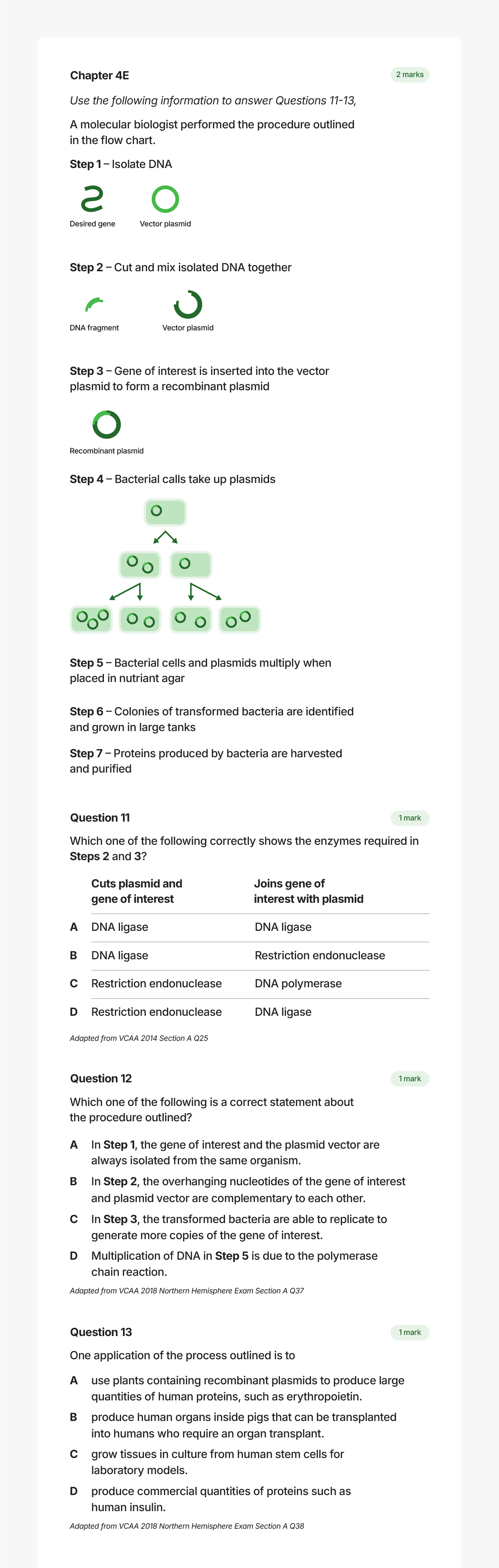
VCE Biology 2025 exam question and Edrolo question
The questions in all courses are written by experienced VCE teachers and mapped backwards from exam success. The questions model the specific content and skills that students will need to be able to demonstrate on the exams, well before they tackle the real thing.
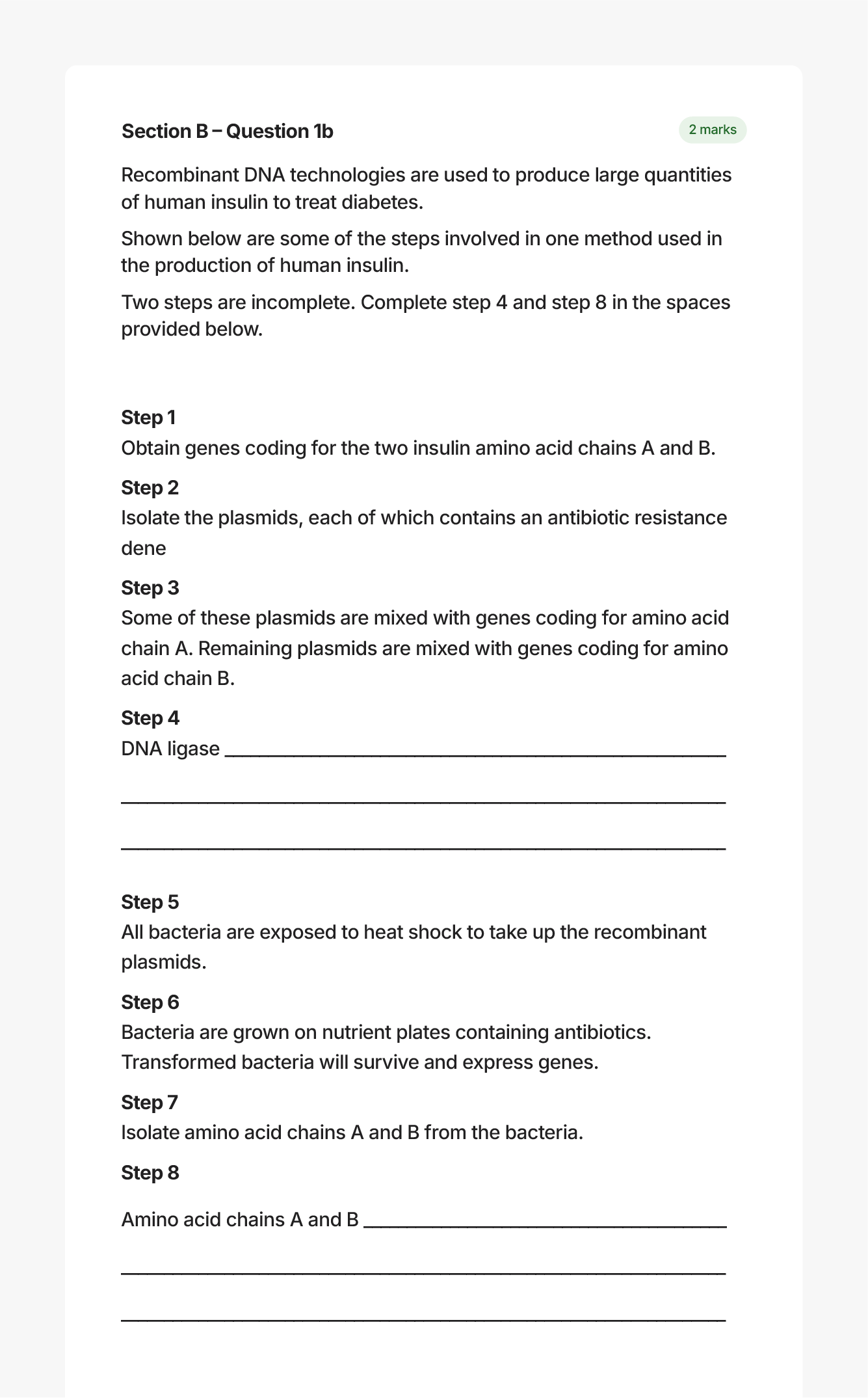
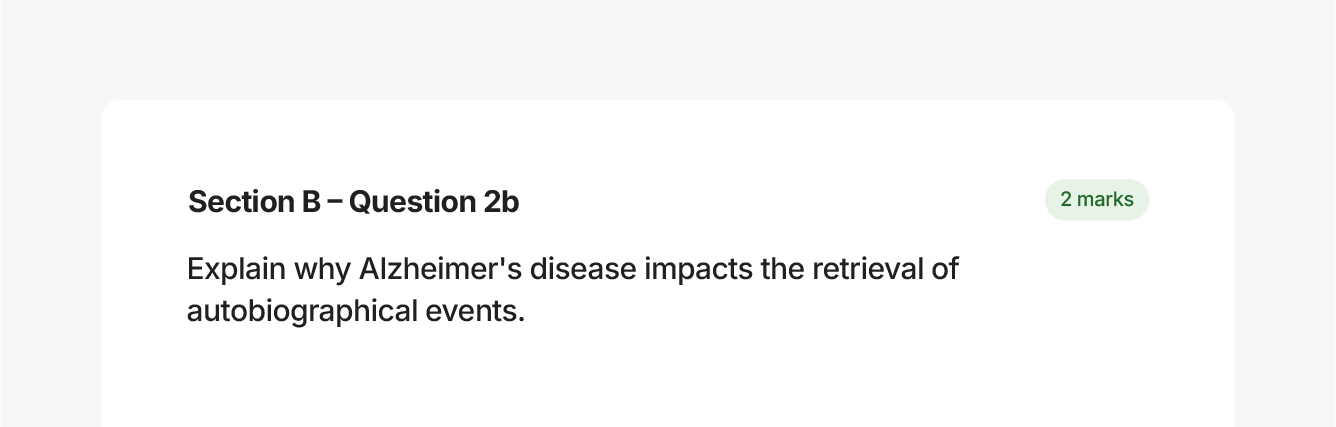
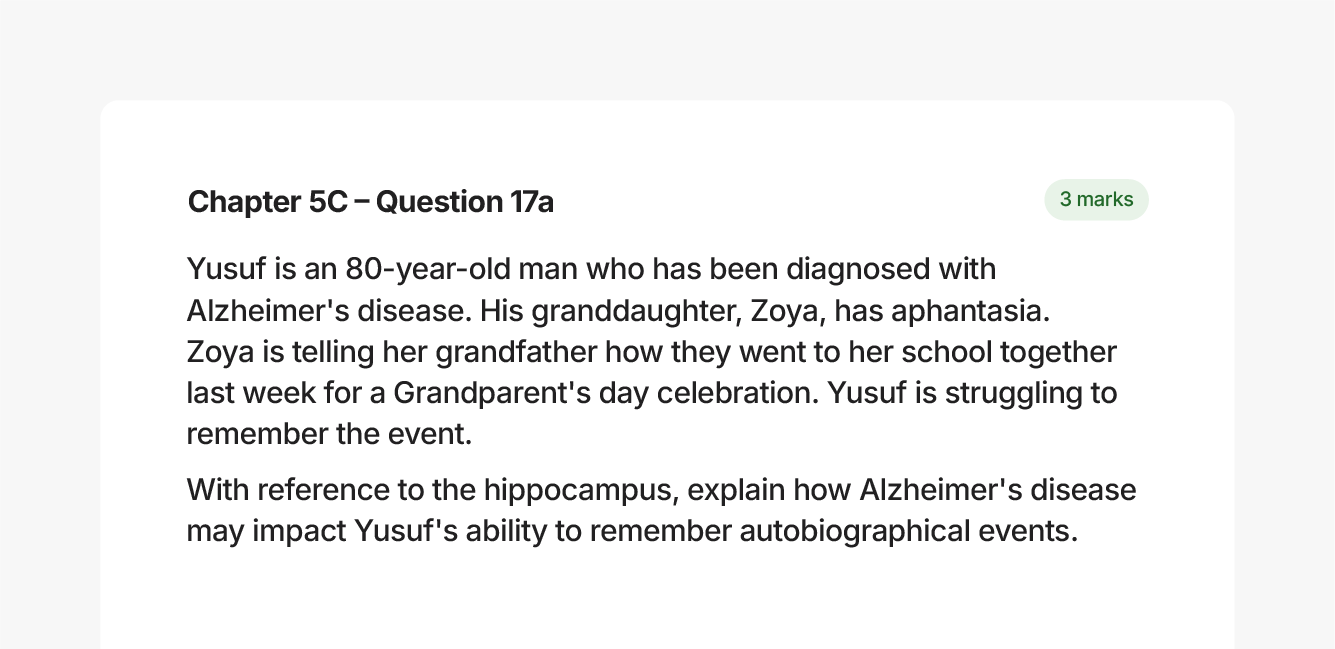
VCE Psychology 2025 exam question and Edrolo question
Both of these questions require:
- Students to 'explain' how or why Alzheimer's disease impacts retrieval of autobiographical events
- Explain task word in a short-answer question
- They vary slightly in that Edrolo's questions requires application to a hypothetical scenario whereas VCAA's does not, but this is good practice as common in other exam questions also
Years 7-10 Science
Edrolo Years 7-10 Science for the Victorian Curriculum 2.0 is the only resource in the market for Years 7-10 that explicitly teaches skills progressively across the junior years.
The key science skills units and questions scaffold students’ familiarity and confidence in skills, and expose them to the types of questions and problems they’ll encounter in senior sciences. Skills are then embedded across topics with activities for students to put these into practice. Plus, the new Like a scientist video series with 7NEWS meteorologist Jane Bunn further helps students put skills into context using real world phenomena.